

Flattened Sunset
Purpose
Simulates atmospheric refraction using a sugar-water density gradient. Students observe a circular light source progressively flatten as it descends through the gradient, explaining why the Sun and Moon appear elliptical near the horizon.
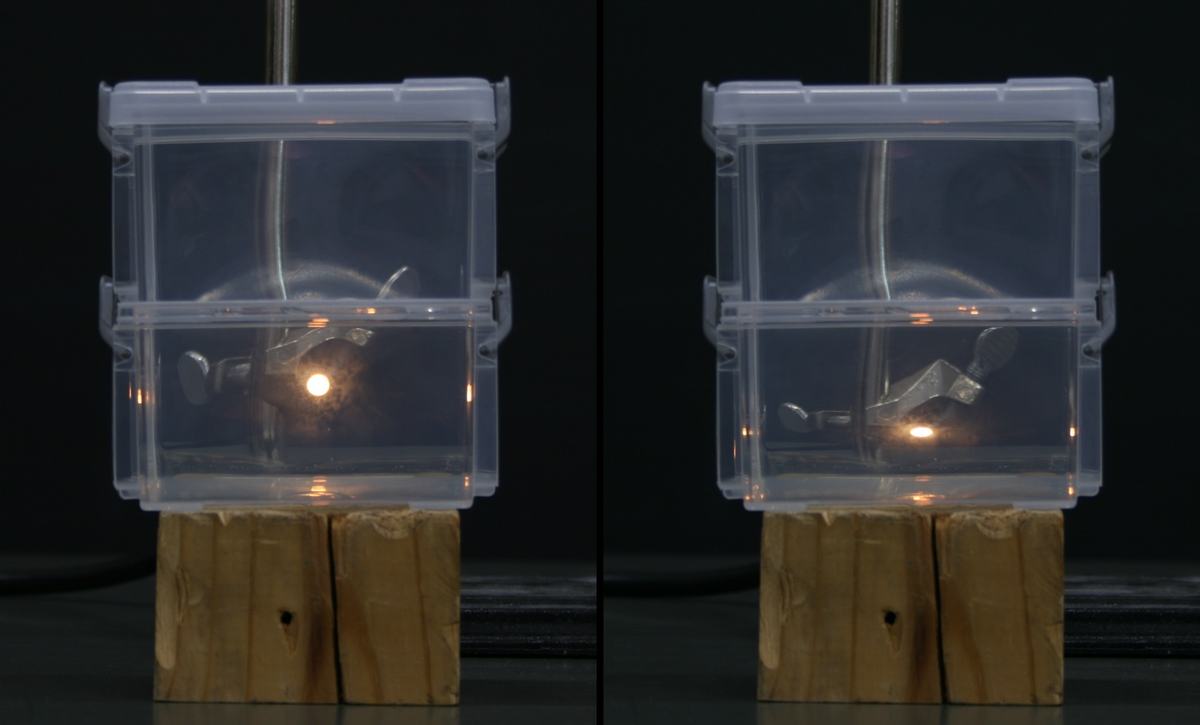


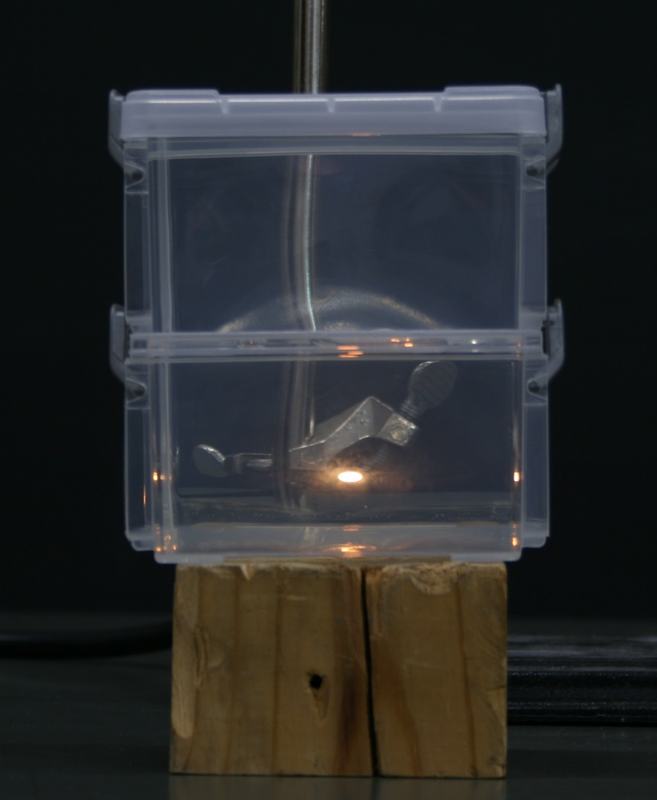

Figure 1:
Stereo pair showing the two stacked containers on wooden blocks. The fiber optic light source is visible at the boundary between the upper (uniform water) and lower (sugar-water gradient) containers.
Figure 2:
Light source in the upper container (uniform water) appears circular, representing the Sun high in the sky above atmospheric density gradients.
Figure 3:
As the light descends toward the density gradient, it begins to show slight vertical compression.
Figure 4:
Light in the density gradient region of the lower container shows noticeable vertical compression, simulating the Sun near the horizon.
Figure 5:
Deeper in the sugar-water gradient, the light appears strongly flattened, mimicking the Sun's appearance just above the horizon at sunset.
Figure 6:
Near the bottom of the gradient, maximum flattening is visible. The vertical dimension is strongly compressed while the horizontal dimension is unchanged.