

Falling Chimney - Free-Fall Paradox
Purpose
A hinged stick ("chimney") rotates faster than a ball bearing free-falls, so the cup at the end of the stick catches the ball. Students see that rotational acceleration can cause points on a rigid body to exceed free-fall acceleration — a counterintuitive result that connects torque, moment of inertia, and angular acceleration.

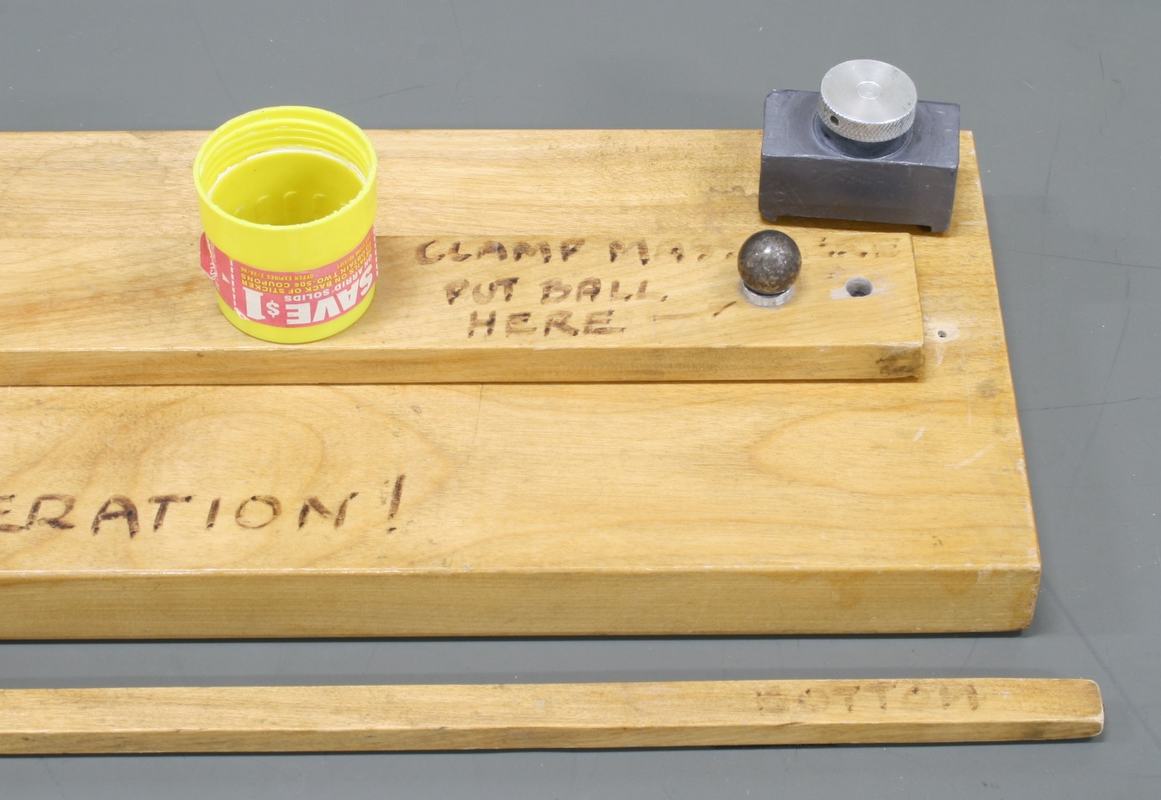

Figure 1:
The complete falling chimney apparatus in its ready position, with the support bar holding the stick at an angle. The yellow cup at the top will attempt to catch the falling ball bearing when the support is removed.
Figure 2:
Detail of the pivot end showing the ball bearing positioned in its metal cradle. The apparatus includes an optional lead mass (visible) that can be attached to shift the center of mass to demonstrate the condition where the ball stays in the cup throughout the fall.
Figure 3:
Side view showing the curved base design and the relationship between the pivot point, support bar, and the ball position. The center of mass location determines whether the cup falls faster than, slower than, or at the same rate as the ball.
Demo Apparatus
- 1