

Dielectrics
Purpose
Students observe real-time capacitance changes as different dielectric materials (acrylic, wood, Teflon, Bakelite) are inserted between parallel plates connected to a capacitance meter. Demonstrates the relationship \(C = \epsilon_0 \epsilon_r A/d\) and how material properties affect capacitance.
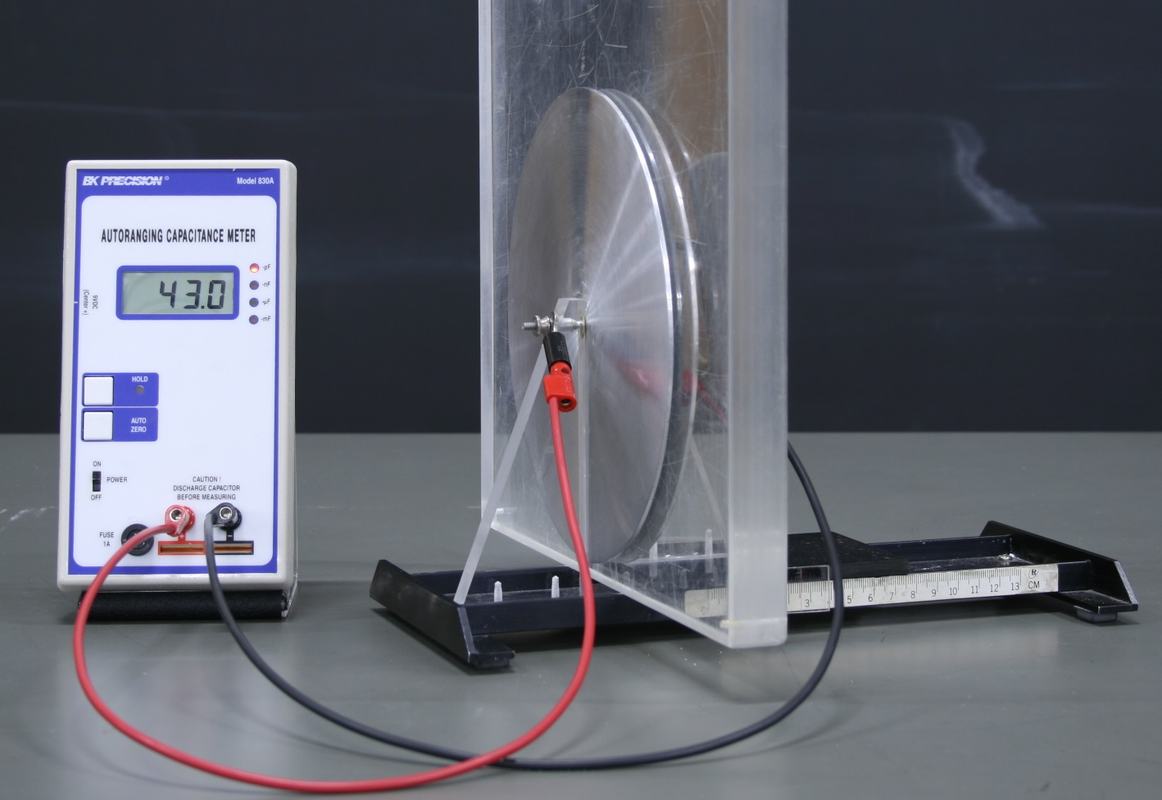


Figure 1:
Initial configuration showing the air-gap capacitor reading approximately 43 pF. This baseline measurement represents the capacitance with air (εᵣ ≈ 1) as the dielectric.
Figure 2:
A dielectric slab inserted between the plates. The reading drops to 23.1 pF because the thick slab pushes the plates further apart, increasing d and reducing capacitance despite the higher εᵣ.
Figure 3:
Bakelite board (εᵣ ≈ 4–5) inserted between the plates, reading 28.8 pF.
Figure 4:
White dielectric slab—likely acrylic (εᵣ ≈ 2.7) or Teflon (εᵣ ≈ 2.1)—inserted between plates, reading 25.0 pF.
Figure 5:
Wood dielectric (εᵣ ≈ 2–4, varies with grain and moisture) inserted between the plates, reading 30.9 pF.
Demo Apparatus
- 1