

Gaussian Surface Models
Purpose
Physical models of the three Gaussian surface geometries (spherical, cylindrical, planar) help students visualize these abstract mathematical surfaces. Students develop intuition for selecting the appropriate Gaussian surface based on charge distribution symmetry.


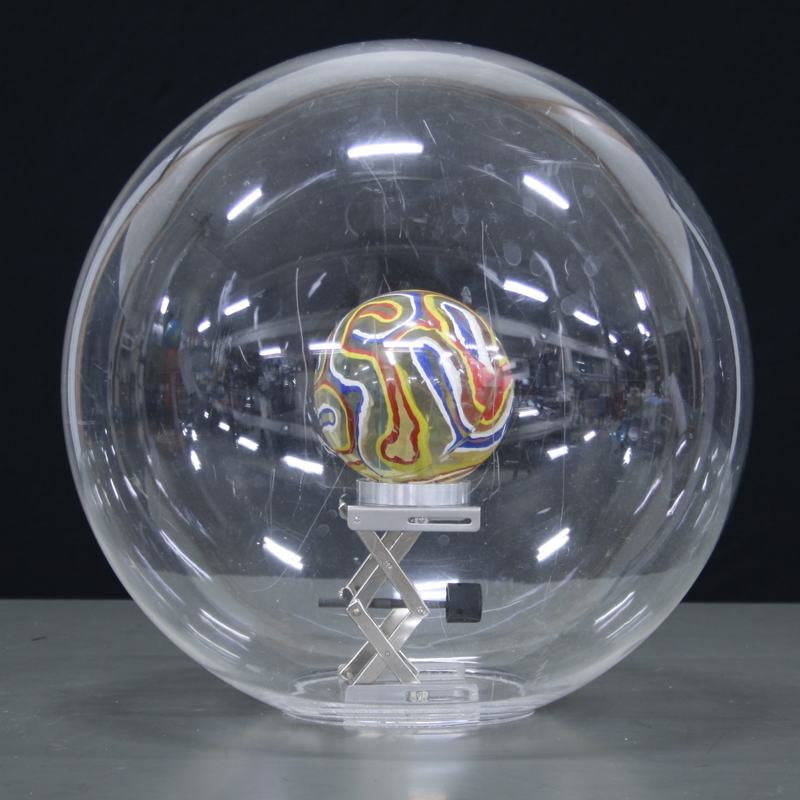
Figure 1:
Cylindrical Gaussian surface model demonstrates the geometry used for calculating electric fields from infinite line charges or uniformly charged cylindrical conductors. The rod represents the charge distribution along the symmetry axis.
Figure 2:
Planar Gaussian surface model illustrates the pillbox geometry used for infinite charged planes or sheet charge distributions. The flat surface emphasizes the perpendicular orientation of electric field lines to uniformly charged planes.
Figure 3:
Spherical Gaussian surface model shows the geometry for calculating fields from point charges or spherically symmetric charge distributions. The centered marble represents a point charge or the center of a spherical charge distribution.
Demo Apparatus
- 1