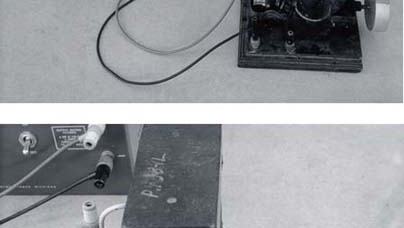
A permanent-magnet DC motor with exposed components shows how a commutator reverses current direction each half-turn to maintain continuous rotation. Useful for explaining commutator operation and the force on current-carrying …
A simple homemade DC motor demonstrates the force on a current-carrying conductor in a magnetic field . Students see electrical energy converted to rotational kinetic energy and learn why commutation …
Students observe how a single electromagnetic machine functions as both a motor and a generator, demonstrating the reversibility of electromechanical energy conversion. The demo also illustrates electromagnetic braking via armature …
Students observe the conversion of electrical energy to mechanical rotation in a DC motor, illustrating the Lorentz force on current-carrying conductors and the role of the commutator in maintaining continuous …
A motor built from just a battery, magnet, and copper wire demonstrates the Lorentz force in its simplest form. Students see how current in a magnetic field produces continuous rotation …
Students see Faraday's law in action by hand-cranking a coil in a magnetic field and observing the induced voltage on a light-beam galvanometer. Switching the brushes between slip rings (AC …
Demonstrates Faraday's Law by generating visible current through relative motion between a coil and magnet. A hand-held 1364-turn coil oscillated through a radar magnet's poles lights a miniature lamp, with …
Demonstrates motor-generator duality by electrically coupling two hand-cranked generators so cranking one drives the other. Students observe Faraday's law, Lenz's law (back-EMF felt as cranking resistance), and the asymmetric behavior …
Students experience the connection between mechanical work and electrical power by cranking a magneto generator to light different bulbs. The dramatic difference in cranking effort between a 25W incandescent bulb …
A volunteer pedals a bicycle connected to a generator to light an array of bulbs, giving students a visceral sense of the mechanical effort required to generate electrical power. Adding …