A figure climbs a ladder leaning against a block, demonstrating that mass *distribution* — not total mass — determines stability. The system is stable with the figure at the bottom …
Demonstrates the counter-intuitive nature of torque. Depending on the angle of the ribbon, the spool rolls toward the pull, away from it, or slides without rotating. The critical angle where …
Demonstrates how a non-uniform mass distribution affects rolling motion. On a level surface, the disk always rolls back to place its center of mass at the lowest point. On an …
Rubbing two metal blocks together produces a grating sound, making audible the microscopic surface interactions that cause friction. Students hear direct evidence that friction converts mechanical energy into sound and …
Demonstrates that friction force is independent of contact area. Blocks pulled in series (large contact area) and stacked (small contact area) require the same force on the spring scale, directly …
Interleaved index cards and a folded paper loop demonstrate that friction scales with the number of contact surfaces and with perpendicular applied forces. Doubling the number of overlapping card sections …
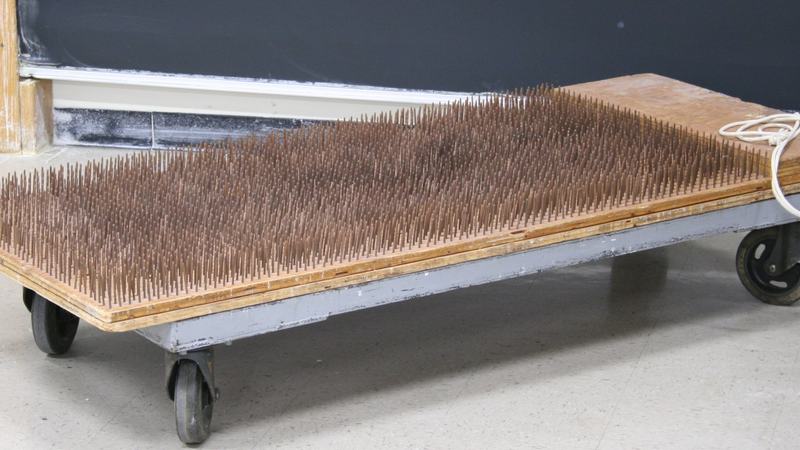
Demonstrates that pressure is inversely proportional to contact area . A person's body weight distributed across hundreds of nails keeps the pressure at each point well below the skin puncture …