Experimentally locates the center of gravity of an irregular board by hanging it from different points and marking plumb lines. Students see that the CG must lie along every vertical …
Sliding hands along a meter stick always converge at the center of mass, regardless of starting position. Comparing a uniform stick (hands meet at 50 cm) with a weighted stick …
Demonstrates that rotation appears smooth when viewed about the center of mass but wobbles when viewed about the geometric center. Students see directly why center of mass is the natural …
A Leaning Tower of Pisa model balances stably without its top piece. Adding the top shifts the center of gravity beyond the base, and the tower topples — showing that …
Demonstrates the Tower of Lire: marked blocks are stacked so the top block extends completely beyond the table edge while maintaining static equilibrium. Students see that the maximum overhang follows …
Demonstrates how center-of-gravity position relative to the base of support determines balance. Students see that a person (or articulated figure) standing with heels against a wall cannot bend forward to …
Funnels placed in three orientations demonstrate stable, unstable, and neutral equilibrium. Students see how center-of-mass position relative to the support determines the equilibrium type and the system's response to perturbation.
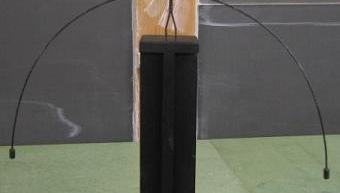
Demonstrates stable equilibrium by showing that when the center of mass is below the pivot point, the system returns to equilibrium after displacement. The figure's long weighted arms lower its …
The wooden stand cannot balance on its own, but adding the wine bottle shifts the system's center of mass over the support point, creating an improbable-looking stable equilibrium. Demonstrates how …
A flexible basswood strip bends visibly under load, showing that normal forces arise from elastic deformation of the supporting material. Heavier masses produce greater deflection, making the connection between deformation …
A cart with lead bricks stays in equilibrium with 3 kg hanging from each side, but slides when 6 kg hangs from one side and the other rope is anchored. …
A mass hangs from a string while a spring scale attempts to pull the string horizontal. Students see that no matter how hard they pull, the string cannot be made …
A volunteer holds a bar by its handle and tries to keep it horizontal while a 1 kg mass is hung from progressively farther notches. Students feel (or watch someone …
A set of wrenches ranging from tiny to a 24-inch behemoth illustrates how lever arm length affects torque . The dramatic size progression makes mechanical advantage viscerally obvious.
Hanging different masses at different lever arm positions on a pivoted meter stick demonstrates torque balance. Students verify that at equilibrium and predict where to place masses to achieve balance.