

Blackboard Optics Curved Mirrors
Purpose
Parallel light rays from a ray projector reflect from concave and convex mirror blocks on a magnetic blackboard, allowing students to directly observe focal points, spherical aberration, and caustic curves. Ray paths can be traced on paper for quantitative analysis of \(f = R/2\).


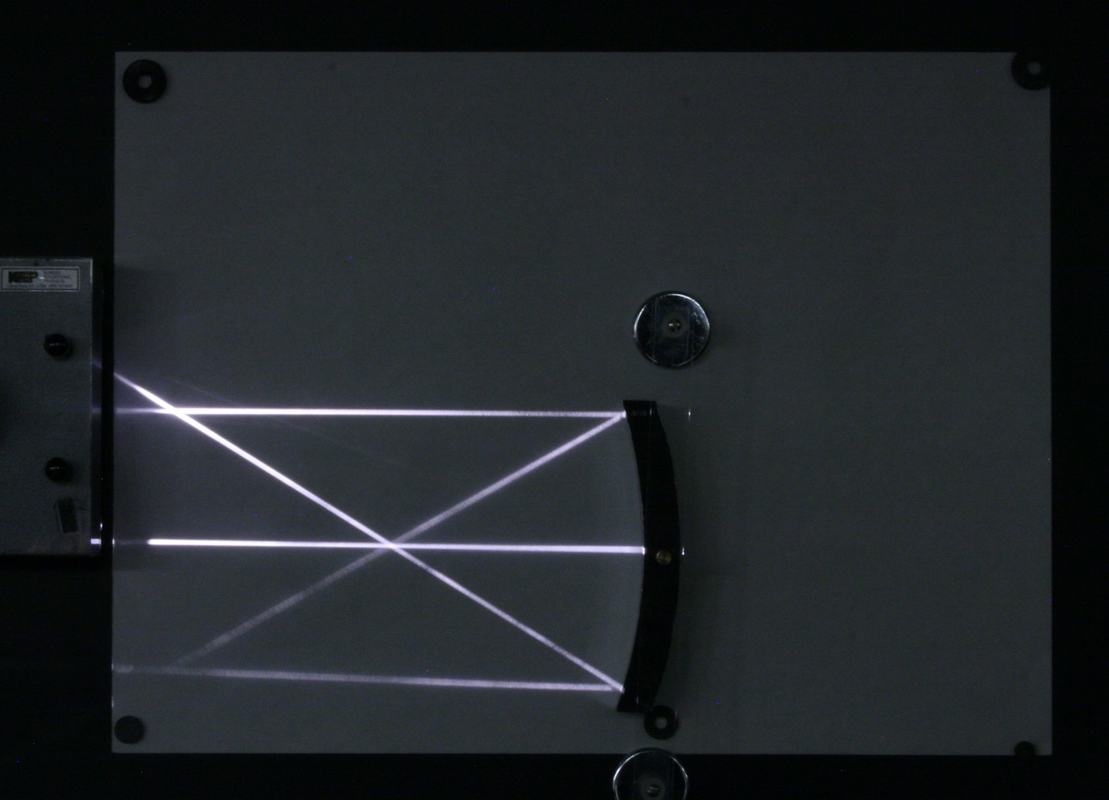
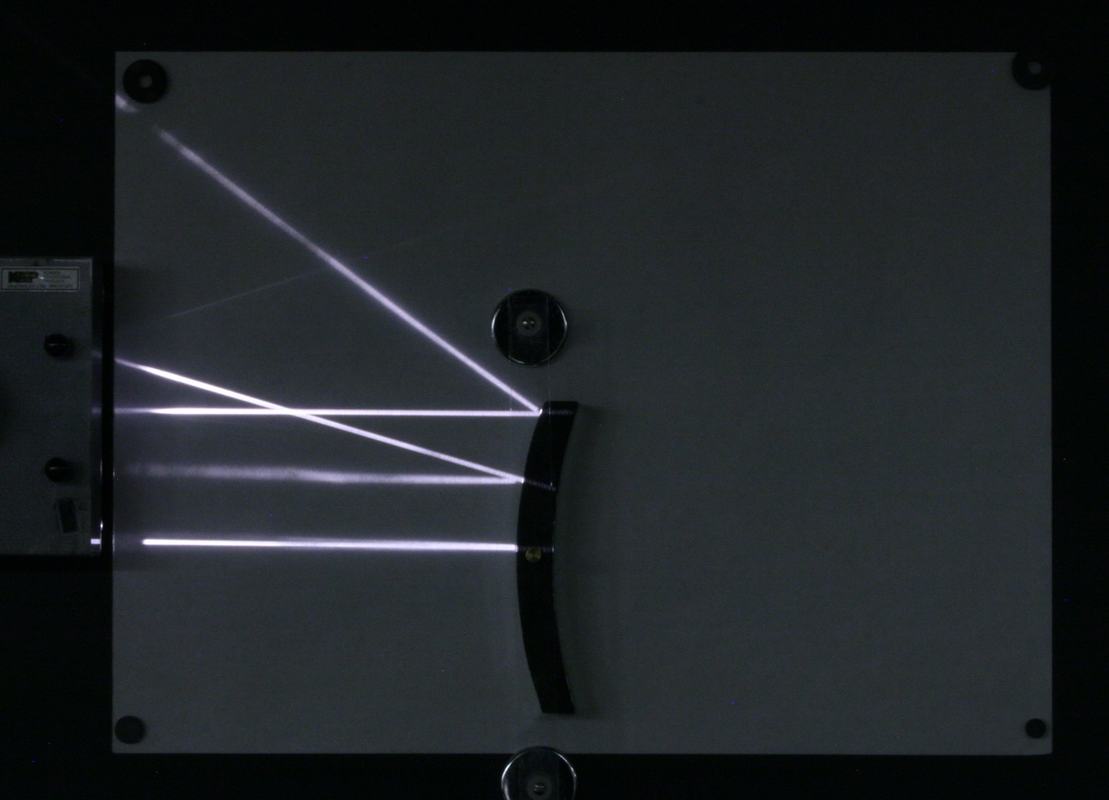
Figure 1:
Parallel rays from the ray projector reflect from a concave mirror surface, converging toward the focal point. The pattern of reflected rays demonstrates the focusing property of concave mirrors and the formation of caustic curves.
Figure 2:
A simplified configuration using three parallel rays clearly illustrates the basic principle of convergence from a concave mirror. This minimal setup is ideal for introducing focal point concepts before showing more complex caustic patterns.
Figure 3:
The curved mirror positioned to show the envelope of reflected rays forming a caustic curve. This configuration allows students to observe how the collection of reflected rays creates a bright focal region.
Figure 4:
An alternative mirror orientation demonstrating how the curvature affects the reflected ray paths. Faculty can rotate the mirror block to show both concave and convex reflection patterns during a single demonstration.