Thick Lens Concept

Demonstrations in Thick Lens

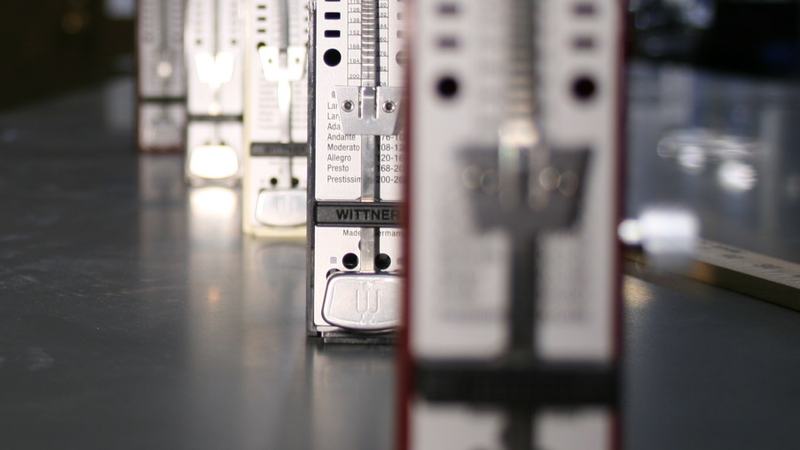
Row of Wittner mechanical metronomes on a lab bench shot from low angle; the nearest red-and-white metronome is sharp while background metronomes progressively blur
Safety

Depth of Field

Shows how lens aperture controls depth of field — the range of distances that appear in focus simultaneously. Students see the trade-off between light gathering (wide aperture) and depth of …
Large-format wooden view camera with ground glass plate on an optical bench, with a lamp covered in aluminum foil (pinholes visible) to the right
Safety

Depth of Focus

Demonstrates how aperture size controls depth of focus. Students observe that reducing the aperture of a camera allows pinholes to remain in focus over a wider range of image-plane positions, …
Large plano-convex lens in holder projecting an image of the fiber optic cable end onto a screen, showing color fringing with orange and white edges from chromatic aberration
Safety

Chromatic Aberration of a Lens

Students observe that a simple plano-convex lens cannot simultaneously focus red and blue light, demonstrating chromatic aberration from wavelength-dependent refraction. Comparing with an achromatic projection lens shows how doublet designs …
UV fluorescent tube mounted vertically on a ring stand with parallel clamp. The aluminum case and power supply sit on the table beside it.
Safety

Chromatic Aberrations in the Eye

Demonstrates chromatic aberration in the human eye. Students observe a purple halo around a UV lamp that they cannot bring into sharp focus simultaneously with the blue tube — direct …
Lens on a tripod stand with annular aperture, carbon filament lamp behind it in a large black cone shade. A projected image of the filament is visible on the wall at left. Ruler on table for measuring focal distance.

Spherical Aberrations of Mirrors and Lenses

Shows that rays passing through outer zones of a lens or mirror focus at different distances than paraxial rays — spherical aberration. Students see that the thin-lens equation is an …
Top-down view of two beakers on red paper with a letter printed on it. Left: dry glass spheres obscure the letter. Right: glass spheres submerged in water become transparent, revealing the letter beneath

Glass Spheres in Water

Demonstrates how refractive index contrast at interfaces determines optical behavior. Dry glass spheres appear opaque due to multiple glass-air reflections; adding water reduces the index mismatch, making the spheres nearly …
Setup: fiber optic lamp and power supply on left, condenser on ring stand in center, water-filled aquarium on wooden block on right
Safety

Air Lenses

Air-filled lenses submerged in water reverse the expected behavior: convex shapes diverge light and concave shapes converge it. Students see directly that lens action depends on the refractive index contrast …
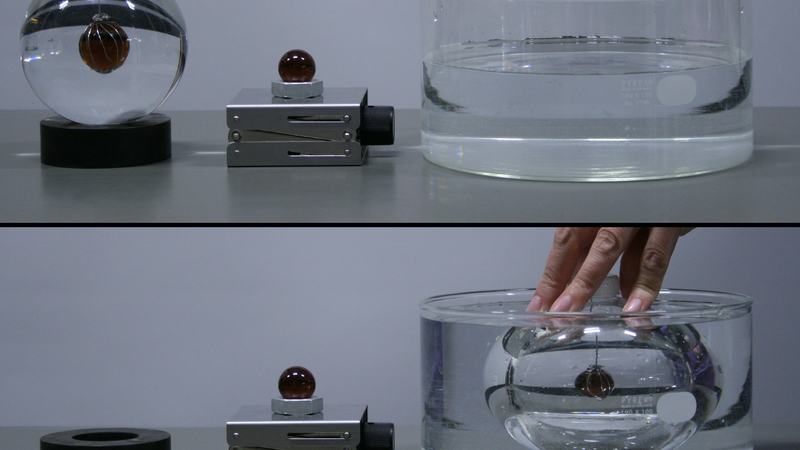
Two-panel image. Top: water-filled spherical globe on rubber ring with magnified marble visible inside, reference marble on lab jack, empty cylindrical glass dish. Bottom: globe submerged in water-filled dish with hand pushing it down, marble appears smaller.

Spherical Water Lens

A water-filled spherical globe magnifies a suspended marble in air, but the magnification nearly vanishes when the globe is submerged in water. Students see directly that lensing power depends on …
Large octagonal Fresnel lens propped upright and smaller square Fresnel lens lying flat, with a wooden ruler and small white cube for scale
Safety

Fresnel Lens

Show how Fresnel lenses use concentric grooves to achieve the focusing power of a conventional thick lens with drastically reduced thickness and weight. Students examine the groove structure and verify …