

Blackboard Optics Total Internal Reflection
Purpose
Students observe total internal reflection using plexiglass blocks and a ray projector on a magnetic blackboard. Any of the available block shapes (triangular, semicircular, rectangular) can be oriented to demonstrate TIR when the internal angle of incidence exceeds the critical angle (~42° for plexiglass-air).

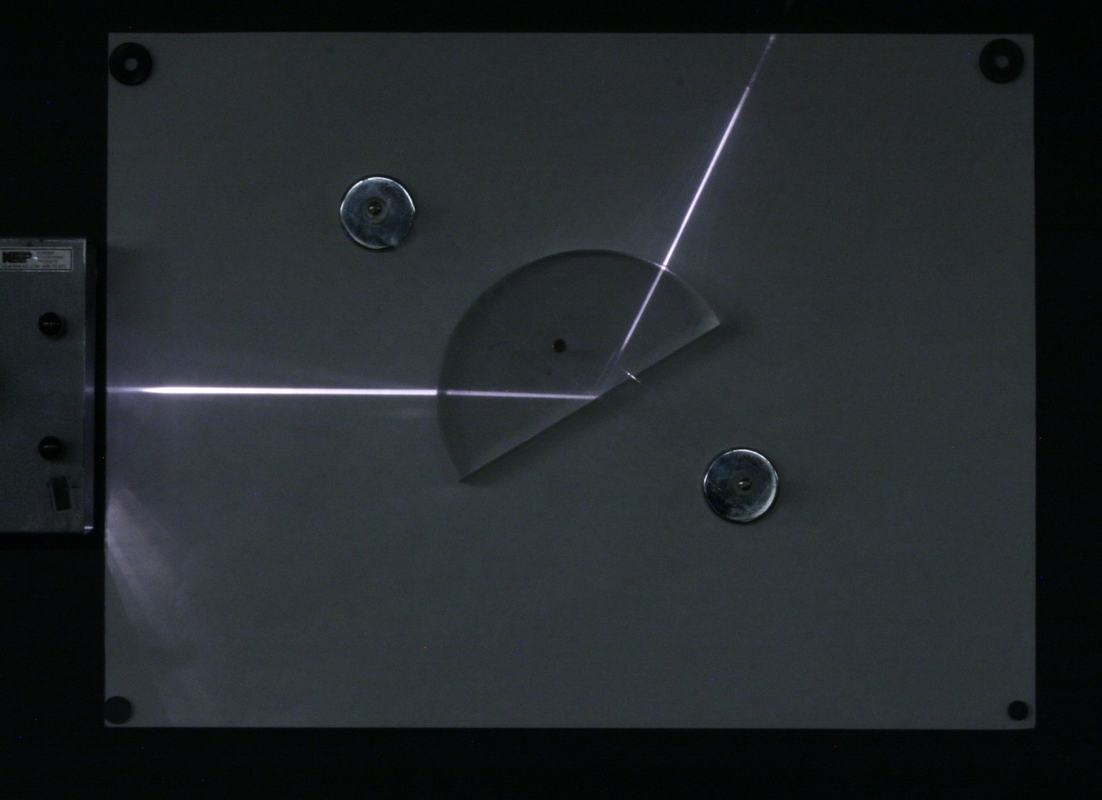


Figure 1:
Light ray incident at less than the critical angle, showing both partial reflection and refraction at the plexiglass-air interface. Note the relative intensities of the reflected and transmitted beams.
Figure 2:
As the angle of incidence increases toward the critical angle, the reflected beam intensifies while the refracted beam weakens and bends closer to the interface.
Figure 3:
Total internal reflection achieved: the incident ray is completely reflected with no refracted beam emerging from the block, demonstrating the phenomenon above the critical angle.
Figure 4:
Multiple internal reflections within the prism geometry, demonstrating how total internal reflection can be used to redirect light through multiple bounces in optical systems.