Two parabolic mirrors at opposite ends of the lecture bench focus thermal radiation from a candle (or heated iron ball) onto a Crookes radiometer. Students see that radiant energy -- …
Demonstrates radiative energy transfer — heat propagating through space without a medium. Use with a Crookes radiometer to visualize radiant energy, or with Leslie's cube to show how surface properties …
A black box with a small opening illustrates the cavity approximation to an ideal black body. Light entering the hole undergoes multiple internal reflections and is effectively absorbed, making the …
Radiant energy transfer imparts motion: both visible and infrared radiation cause the radiometer vanes to spin. Students see a concrete example of electromagnetic energy converting to mechanical motion and observe …
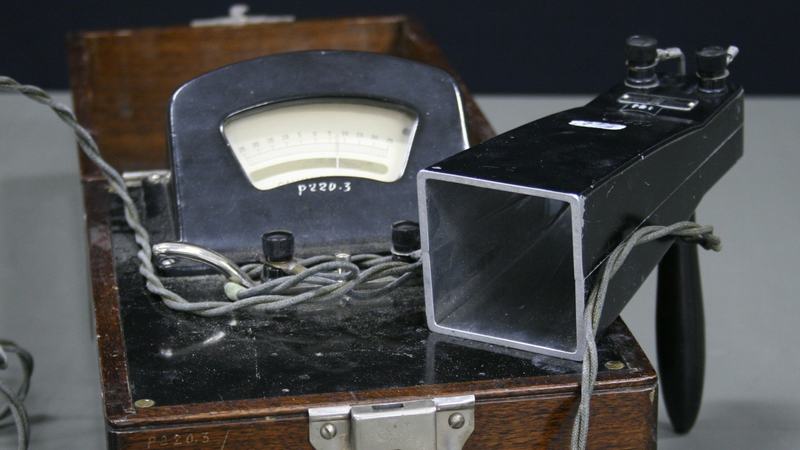
Detect and measure thermal radiation using a thermopile and light-beam galvanometer. The setup is sensitive enough to show the infrared radiation from a person's hand on the projection board, demonstrating …
Surfaces with different emissivities radiate different amounts of energy at the same temperature. The differential thermometer makes this visible: the fluid shifts toward the side receiving less radiation, showing that …
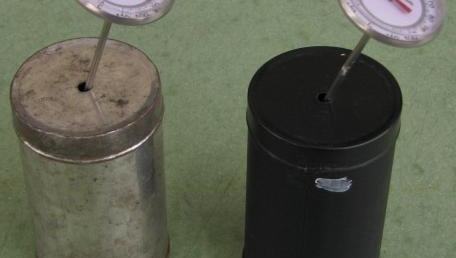
Two identical cans -- one black, one reflective -- filled with boiling water cool at different rates. The black can cools faster, demonstrating that high-emissivity surfaces radiate thermal energy more …
Demonstrates that light carries energy by showing a thermometer inside an absorption cell reaches a higher equilibrium temperature than an external reference thermometer when illuminated. Provides direct evidence that electromagnetic …