Optical Slider

Details

9AA200 - Lab Hardware

1 unit available to reserve

Used in these demonstrations

Setup: fiber optic lamp and power supply on left, condenser on ring stand in center, water-filled aquarium on wooden block on right
Safety

Air Lenses

Air-filled lenses submerged in water reverse the expected behavior: convex shapes diverge light and concave shapes converge it. Students see directly that lens action depends on the refractive index contrast …
Optical rail with concave mirror in cross clamp, unlit candle in glass holder on flat carriage, foam core board divider, translucent screen, and labeled flags marking focal point F and center of curvature C
Safety

Center of Curvature

A candle and translucent screen on an optical rail show how image location, size, and orientation change as the object moves relative to the focal point and center of curvature …
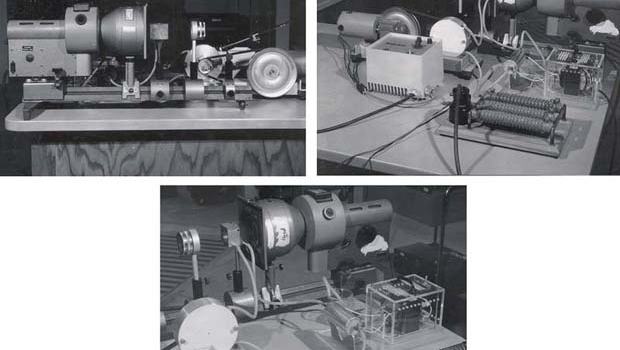
Three views of the critical point apparatus: optical bench with arc lamp and condensing lenses (top left), boiler with pump motor and Ratiotrol control box (top right), and complete setup showing mirror, projection lens, Freon cell, and fluid circulation system (bottom)
Safety

Change of Phase

Students observe the liquid-gas phase transition at the critical point of Freon-115 , witnessing critical opalescence and the disappearance of the meniscus as the distinction between liquid and gas vanishes. …
Green laser passing through Cornell plate mounted on ring stand with finger clamp, producing a horizontal interference pattern on white paper magnetically attached to blackboard
Safety

Cornell Plate Double-Slit Interference

A laser illuminates double slits on a Cornell plate, producing an interference pattern on a distant screen. The Cornell plate has multiple slit configurations (varying separation, width, and number of …
Green laser and Cornell diffraction plate mounted on optical rail, with single-slit diffraction pattern projected on white paper attached magnetically to the blackboard
Safety

Cornell Plate Single-Slit Diffraction

Demonstrates single-slit Fraunhofer diffraction using a Cornell plate with calibrated slits of varying widths. Students observe the inverse relationship between slit width and diffraction pattern width, with quantitative verification possible …
Four views of the apparatus: radar magnet with pole piece (top left), full setup with magnet on lab jacks and optical bench (top right), close-up showing condenser lens (bottom left), and projected shadow of a suspended sample between pole pieces (bottom right)
Safety

Diamagnetism and Paramagnetism

Suspended samples in a non-uniform magnetic field demonstrate diamagnetic behavior. Bismuth, one of the strongest common diamagnets, visibly orients perpendicular to the field lines. Students see that all materials respond …
Three small opaque dots on a white disk held in a blue-handled finger clamp on a metal post
Safety

Diffraction around Opaque Disk

Demonstrates Poisson's (Arago's) bright spot: light diffracting around an opaque disk produces a counterintuitive bright spot at the center of the geometric shadow. Provides compelling evidence for the wave nature …
Optical rail with wooden mounts, He-Ne laser with spatial filter at left, optical components along the rail, and metal reflection shield at right end
Safety

Diffraction by a Circular Aperture

Students observe the Airy disk diffraction pattern — a bright central disk surrounded by concentric rings — produced when a laser beam passes through a circular aperture. The inverse relationship …
Green laser diffraction pattern from a wire showing a thin dark central shadow line flanked by bright diffracted light with visible vertical fringes on both sides
Safety

Diffraction from a Wire

A laser beam diffracts around a thin wire, producing a fringe pattern equivalent to single-slit diffraction of the same width (Babinet's principle). Students see that light bends around opaque obstacles …
Green laser diffraction pattern from mesh showing complex multi-directional array of bright spots against dark background
Safety

Diffraction through Mesh

Laser light through circular apertures (0.04 and 0.08 mm) and mesh screens produces Fraunhofer diffraction patterns, demonstrating light's wave nature. Students observe Airy patterns and two-dimensional grating patterns, and verify …
Four green laser single-slit diffraction patterns stacked vertically, from widest slit (top, narrow pattern) to narrowest slit (bottom, wide pattern with many visible side maxima)
Safety

Electroformed Single Slits

Students observe single-slit Fraunhofer diffraction patterns produced by a laser through precision electroformed slits of different widths. Comparing the patterns demonstrates the inverse relationship between slit width and diffraction pattern …
Four horizontal rows of green double-slit interference patterns on a dark background, each showing different fringe spacings and diffraction envelopes corresponding to the four slit configurations
Safety

Electroformed Two-Slit Interference

Laser light through precision double slits produces interference patterns that demonstrate the wave nature of light. Four slit configurations allow direct comparison of how slit width and spacing affect fringe …
Projected soap film showing colorful interference bands of magenta, green, cyan, yellow, and blue swirling across the film against a dark background

Interference in a Soap Film

Students observe thin film interference as colored bands form in a soap film and evolve over time. The projected image shows how constructive and destructive interference between reflections from the …
Cuda I-150 fiber optic light source on left, small square barrier on a clamp mounted on an optical rail, green gridded chalkboard in background — barrier at maximum distance, no visible shadow
Safety

Inverse Square Law

A point light source casts the shadow of a small square barrier onto a gridded board. Each time the barrier-to-source distance is halved, the shadow area quadruples — directly visualizing …
Color reference photograph: checkered mug with Life Savers candy rolls on a floral background
Safety

Land Effect

Two projectors overlay a black-and-white image with a red-filtered image of the same scene. Students perceive blues, greens, and other colors that are physically absent, demonstrating that color vision depends …
Projected diffraction pattern in dark room: bright white zeroth-order stripe on left from projector, first-order continuous spectrum (blue through red) on right with discrete blue, green, and red laser spots visible within it
Safety

Lasers and White Light

Compares diffraction of three individual laser wavelengths (red, green, blue) with white light from a slide projector through the same grating. Students see discrete laser spots at specific angles alongside …
Video camera with flip-out screen at near end of optical bench, convex lens in dark card mount in middle, desk lamp illuminating target card at far end, wooden meter stick along bench
Safety

Microscope Model

Two convex lenses on an optical bench model a compound microscope, producing a magnified, inverted image captured by a video camera. Students see how objective and eyepiece lenses combine for …
Green laser on adjustable stand with Cornell diffraction plate, producing a multiple-slit interference pattern on white paper attached to the blackboard; pattern shows a bright central spot with a few side maxima
Safety

Multiple Slit Diffraction

A Cornell plate provides multiple-slit patterns and gratings of various densities. Students observe how increasing the number of slits sharpens the principal maxima while keeping their angular positions fixed, and …
Projected soap film vibrating at a resonant frequency, showing concentric circular nodal rings with iridescent pink, yellow, and green thin-film interference colors against a dark background
Safety

Normal Modes of a Circular Membrane

Visualizes normal mode vibrations of a circular membrane using a speaker-driven soap film and optical projection. Students observe distinct nodal patterns at resonant frequencies, extending standing wave concepts from 1D …
Anamorphic photo of a Rubik's cube on paper with pencil-drawn shadow lines, appearing as a realistic 3D cube when viewed from the correct angle

Optical Illusions

Three illusions demonstrate how the brain constructs 3D perception from 2D images: an anamorphic Rubik's cube, a hidden photograph revealed by rotation, and a hollow-face dragon that appears convex. Highlights …
Green laser on wooden stand illuminating a holographic plate, projecting a large holographic image of a telephone onto the wall in a darkened room
Safety

Projection Holograms

Demonstrates holographic image projection using laser illumination of transmission holograms. Students see how holograms encode amplitude and phase information, and how illuminating different portions of the plate reconstructs different viewing …
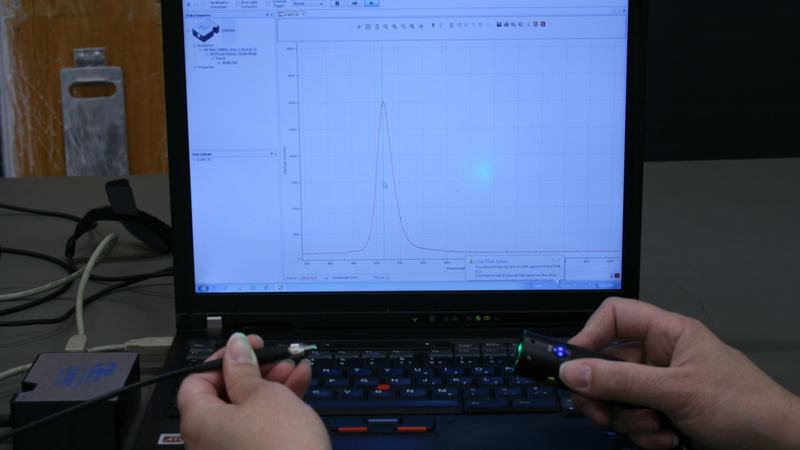
Hands holding fiber optic cable and a green laser pointer aimed at the cable tip, with laptop displaying OceanView software showing a sharp spectral peak; small blue USB spectrometer visible at left
Safety

Spectrometer

Uses a fiber-optic USB spectrometer to display real-time emission spectra of LED and UV light sources. Students see how different sources produce distinct spectral signatures and can measure wavelengths directly.
Three PASCO Scientific transmission diffraction gratings in metal slide mounts, labeled 100 LINES/MM, 300 LINES/MM, and 600 LINES/MM, on a green surface
Safety

Transmission Gratings

Demonstrates how grating line density affects angular separation of diffraction orders. Comparing 100, 300, and 600 lines/mm gratings with a laser, students directly observe that higher line density (smaller) produces …
Green laser and PASCO diffraction wheel mounted on optical rail with optical sliders, projecting a faint green interference pattern onto white paper magneted to blackboard
Safety

Variable Double Slit

Demonstrates double-slit interference with variable slit separation using a laser and PASCO diffraction wheel. Students observe the inverse relationship between slit separation and fringe spacing, providing direct verification of.
Green laser diffraction pattern showing a bright central maximum with secondary maxima arranged in a cross pattern along horizontal and vertical axes
Safety

Variable Rectangular Aperture

Two independently adjustable slits (horizontal and vertical) form a variable rectangular aperture. Students observe in real time how narrowing one dimension widens the diffraction pattern in the perpendicular direction, demonstrating …
Green laser and PASCO diffraction wheel mounted on optical rail sliders, projecting a single-slit diffraction pattern onto white paper attached to the blackboard
Safety

Variable Single Slit

Demonstrates single-slit Fraunhofer diffraction and the inverse relationship between slit width and angular spread. Students directly observe that narrower slits produce wider diffraction patterns by rotating through discrete slits from …
Diverging lens in circular mount on optical rail, with slide frame and colored ABCD card (A on red, B on green, C on yellow, D on blue) mounted on steel plate behind

Virtual Image

Demonstrates the fundamental difference between real and virtual images using a diverging lens. Students observe that a virtual image appears to occupy a definite location in space but cannot be …
Red laser diffraction pattern showing an X-shaped cross with a bright central spot on a dark background
Safety

X-ray Diffraction: Optical Analog

Laser light diffracting through a helical coiled filament produces an X-shaped pattern analogous to the famous "Photo 51" X-ray diffraction image of DNA. Students see how helical geometry produces distinctive …

Reserve This Equipment

Please log in to reserve equipment.