Demonstrates electromagnetic coupling between two spring-mass oscillators via Faraday induction. Students observe energy transfer through induced currents, phase relationships that depend on coil wiring sense, and rapid electromagnetic damping when …
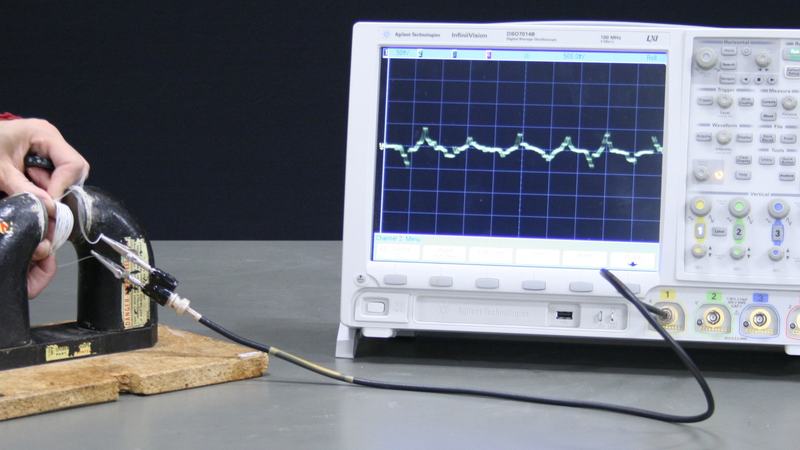
A flexible coil between magnet poles produces voltage pulses visible on an oscilloscope through three methods: waving (translation), rotating, and compressing/extending the coil. Students see that any change in magnetic …
Three coils with different turn counts (30, 50, 90) are connected in series to an overhead galvanometer. Moving a bar magnet through each coil shows that induced EMF scales with, …
Shaking a magnet through a coil generates current that charges a capacitor and powers an LED — a hands-on demonstration of Faraday's law. Students see the complete energy conversion chain …
Demonstrates Faraday's law by dropping a magnet through a coil connected to two oppositely-oriented LEDs. Students see that increasing and decreasing flux produce currents in opposite directions, and that reversing …
A battery-powered electromagnet core inserted into pickup coils produces galvanometer deflection only during switching transients — demonstrating that induced EMF requires changing magnetic flux (Faraday's Law). Reversing the battery leads …
A coil inserted into a strong magnet and flipped 180° produces a voltage pulse on an oscilloscope. Students observe that the pulse height depends on flip speed while the integrated …
Demonstrates Faraday's Law using a demountable transformer core with hand-wound coils. Closing a switch on the primary circuit causes one LED to flash in the secondary; opening it flashes the …
Demonstrates Faraday's law by detecting the EMF induced when a large wire loop is rotated like a jump rope through Earth's magnetic field (~50 μT). Students see that even a …