

Roberval Balance
Purpose
A parallelogram-linkage balance accurately compares masses regardless of where they sit on the pans — an apparent paradox resolved by analyzing the six pivot points. Suspending the balance from a rod reveals the shifted center of mass, distinguishing local equilibrium (the parallelogram) from global equilibrium (the whole system).
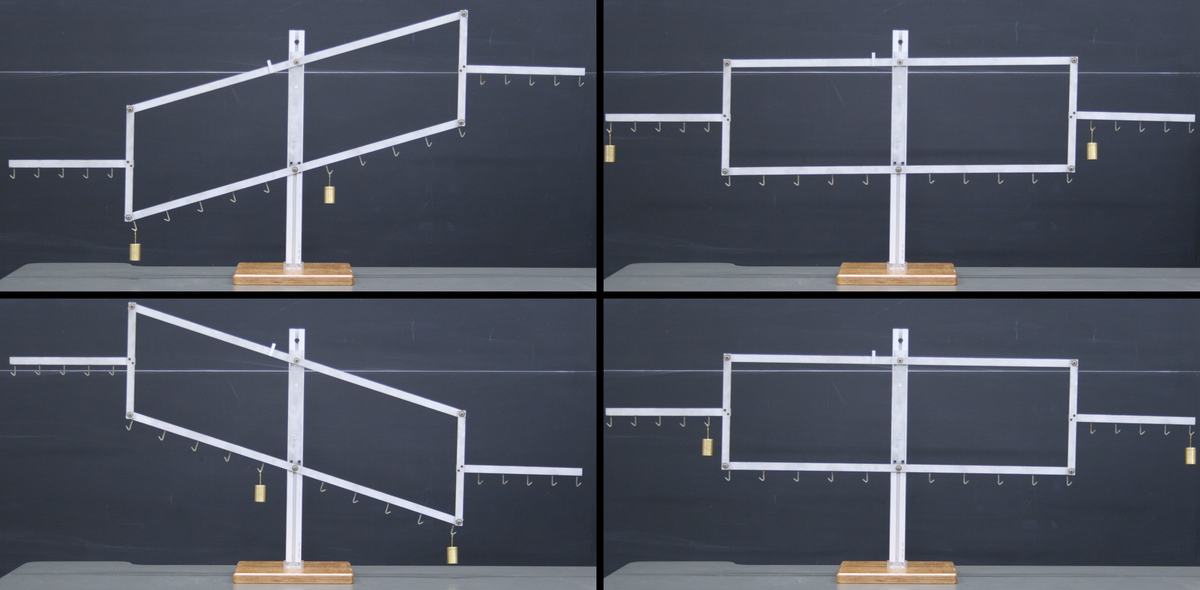

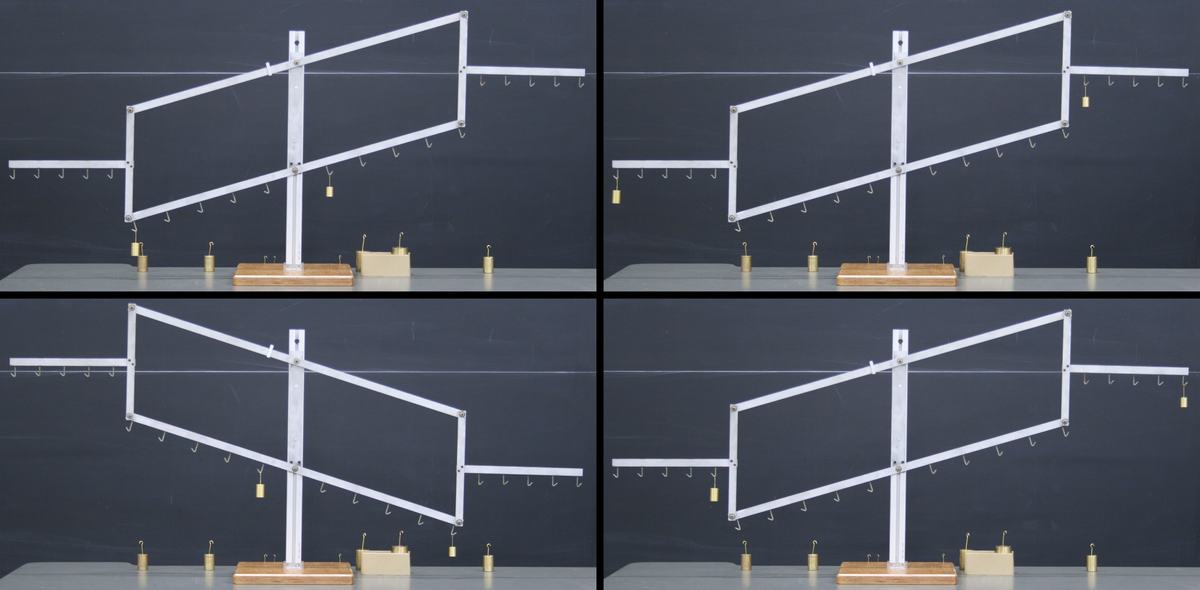
Figure 1:
Various configurations of the Roberval balance showing equal masses at different positions on the horizontal bars and outer arms. Note how the parallelogram remains rectangular in all cases despite asymmetric loading.
Figure 2:
Top: tabletop configuration with mass set. Bottom: suspended from a rod, the entire apparatus tilts when equal masses are placed at unequal distances on the fixed outer arms, revealing the shifted center of mass.
Figure 3:
Top: tabletop configurations with masses at various positions. Bottom: suspended configuration showing the system tilting when equal masses are at unequal distances on the outer arms.