

Polarization by Glass Plate, Not by Steel Plate
Safety Warnings
Warning: Laser Safety
Warning: Reflection Hazards
Purpose
Demonstrates that reflection from a dielectric (glass) polarizes light at Brewster's angle, while reflection from a metal (polished steel) does not. Students see the dramatic contrast when a crossed analyzer blocks the glass-reflected beam but transmits the steel-reflected beam.


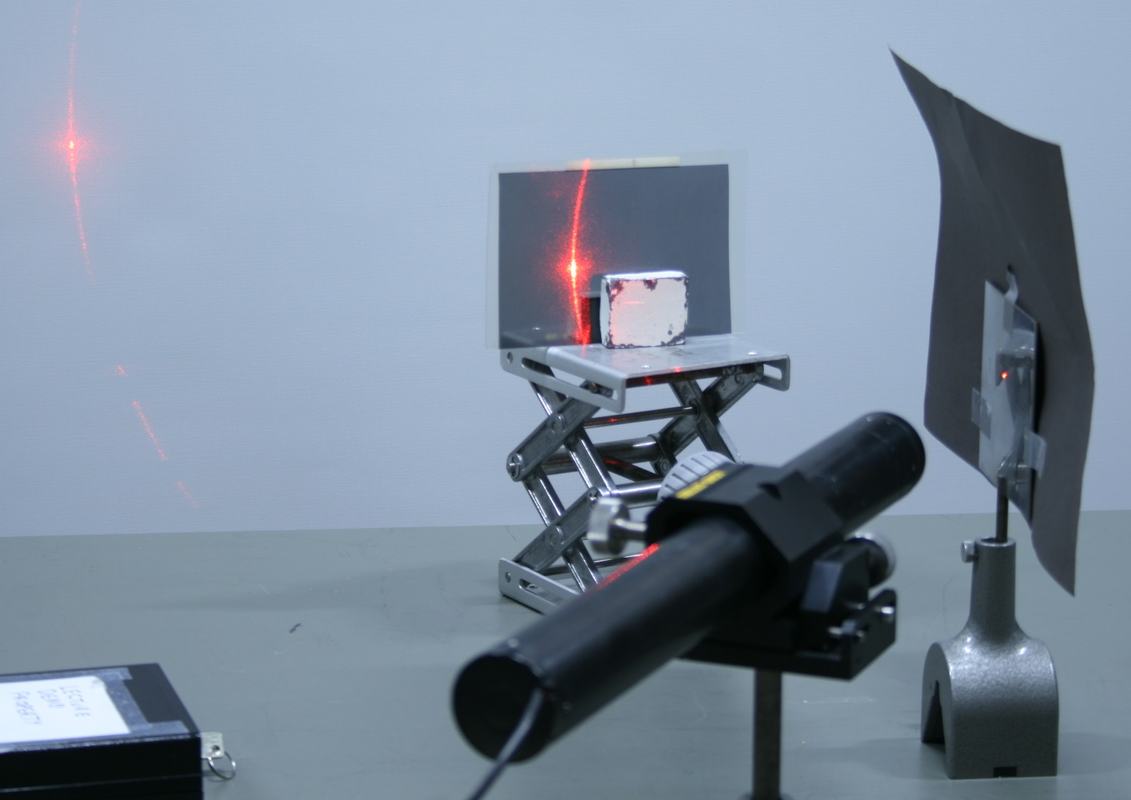
Figure 1:
Setup with He-Ne laser (left), reflecting plate on scissor lift (center), analyzing polarizer (foreground), and glass plate at right. A faint red laser dot is visible on the wall behind the plate.
Figure 2:
Glass plate at Brewster's angle with crossed analyzer: the reflected beam is blocked, confirming complete polarization. Only the incident spot on the plate is visible.
Figure 3:
Polished steel plate with the same crossed analyzer: the reflected beam passes through, producing bright scatter on the wall and analyzer. Metallic reflection does not significantly polarize the light.
Figure 4:
Close-up of steel plate reflection. The bright scatter through the crossed analyzer confirms that metallic reflection preserves the incident polarization state.
Equipment
- 1