

Chladni Figures
Purpose
Sand on a vibrating plate collects along nodal lines, revealing 2D standing wave patterns. Students see how plate geometry and driving frequency determine the mode shapes, connecting resonance and boundary conditions to visible patterns.

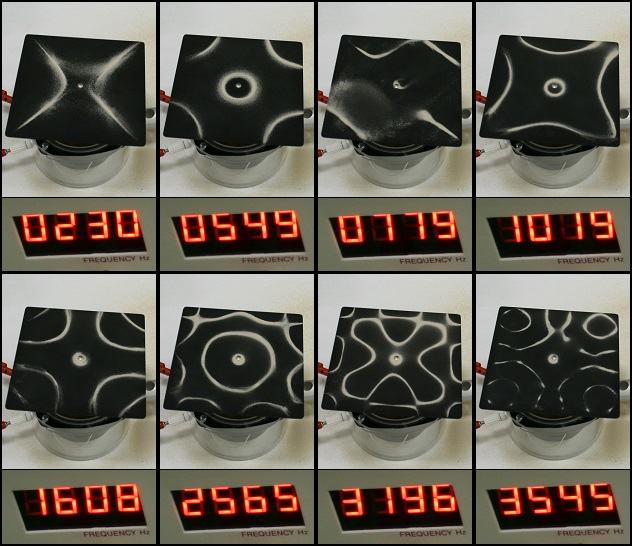
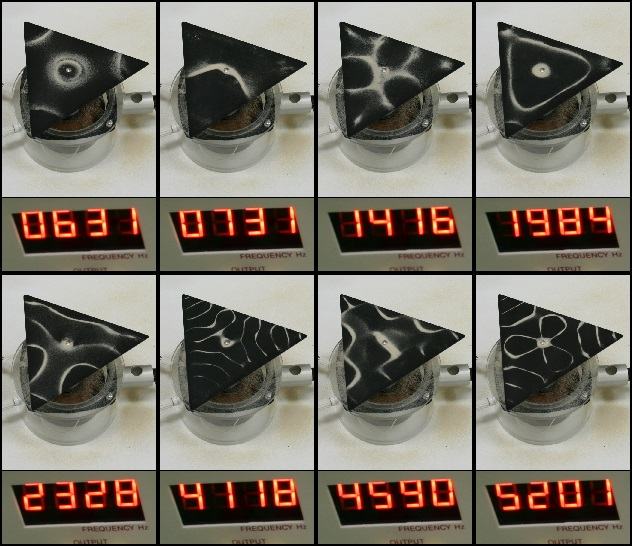
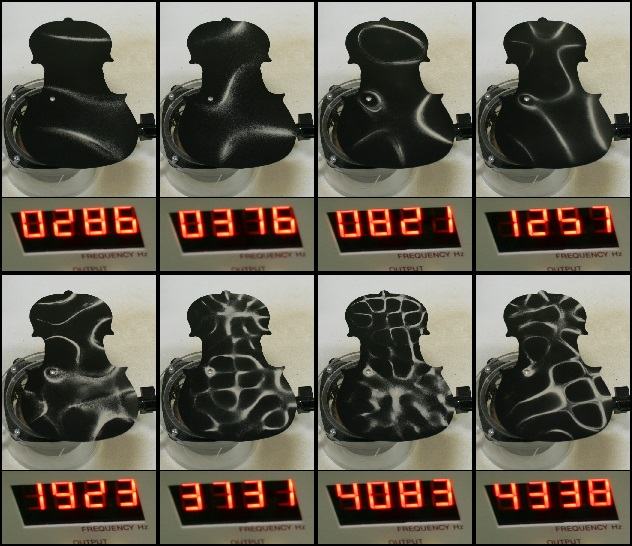
Figure 1:
Different plate geometries (circular and square) produce distinct Chladni patterns. The circular plate exhibits concentric ring modes while the square plate shows symmetric nodal lines, each corresponding to specific resonant frequencies displayed below.
Figure 2:
Progression of square plate modes at increasing frequencies shows how nodal complexity increases with mode number. Higher frequencies produce more intricate patterns as additional nodes subdivide the plate surface.
Figure 3:
Triangular plate geometry constrains vibrational modes differently than circular or square plates, producing unique nodal patterns that reflect the boundary conditions imposed by the three-sided shape.
Figure 4:
Complex, asymmetric geometries produce irregular but reproducible Chladni patterns, demonstrating that even arbitrary shapes support quantized vibrational modes with characteristic nodal lines at specific frequencies.
Equipment
- 1
Demo Apparatus
- 1