Demonstrates pitch dependence on bar length: shorter bars produce higher frequencies. For free bars,, in contrast to strings where.
Demonstrates the relationship between bar length and resonant frequency for solid bars. Wooden blocks of different lengths are knocked off a support to play "Home, Sweet Home," making the length-pitch …
Demonstrates how holding position on a vibrating rod selects which longitudinal standing wave harmonics can persist. Students hear the pitch rise as the hold point moves to positions that enforce …
Sand on a vibrating plate collects along nodal lines, revealing 2D standing wave patterns. Students see how plate geometry and driving frequency determine the mode shapes, connecting resonance and boundary …
Demonstrates how vibrational frequency depends on size in solid plates. Smaller gongs produce noticeably higher pitch, illustrating that for circular plates. The gongs do not produce well-defined tones, making them …
Visualizes 2D standing wave modes on a circular membrane driven by a speaker. A fluorescent rubber sheet under UV light reveals nodal patterns as the driving frequency is swept, connecting …
Visualizes normal mode vibrations of a circular membrane using a speaker-driven soap film and optical projection. Students observe distinct nodal patterns at resonant frequencies, extending standing wave concepts from 1D …
Demonstrates friction-driven resonance in a wine glass. Running a wet finger around the rim excites the glass at its natural frequency, producing a sustained tone whose pitch depends on the …
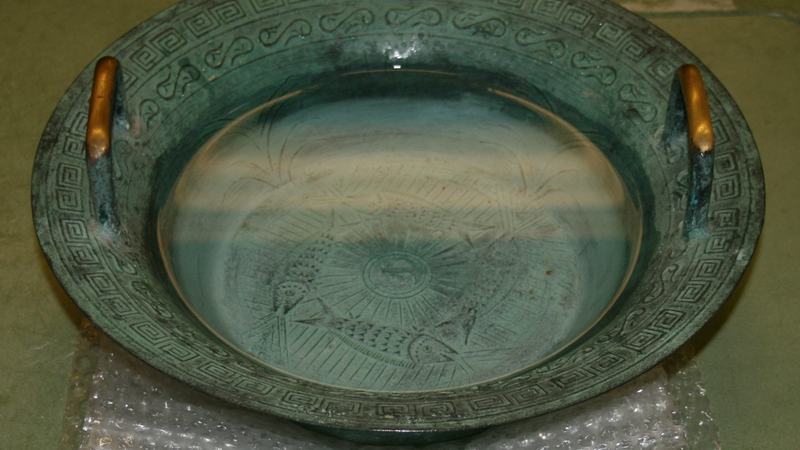
Rubbing the handles of a water-filled bronze bowl excites resonant vibrations that produce audible tones and dramatic standing wave patterns in the water. Students observe acoustic resonance, normal modes, and …
A spinning metal ruler on a string produces a rhythmic rumbling sound and demonstrates coupled rotational motions, aerodynamic lift, and sound generation from a vibrating solid.