

Tissue Toughness
1 Overview
You will measure the energy required to rupture a tissue with a projectile. You will then predict how many tissues your projectile could rupture and test your prediction.
2 Learning Goals
After completing this lab, you should be able to:
- Use the uncertainty in a measured quantity to determine the uncertainty in a calculated quantity.
- Propagate uncertainty in two different ways.
3 Explore: Launch Technique and Setup
Practice launching the ball with and without a tissue in place as described below and as shown in Figure 1. Place the ball in the launcher and use the plastic rod to push the ball down. There are three “clicks” for three different speeds; use one click for this activity. Never allow any part of your body above the launcher in the line of fire! Make sure all tablet computer screens are far away from the launcher and safe from falling metal balls!
Pull the string to launch the ball. Catch it with your hand on the way down. Practice launching/catching the ball.
To hold a tissue in the path of the ball, first secure it in one of the provided plastic hoops as demonstrated in the prelab video. Note that the hoops come apart; place the smaller part on the table, cover it with a tissue, and then push the larger part on top and secure it in place with the metal screw. Next, load the ball in the launcher, and then secure the hoop to the frame.
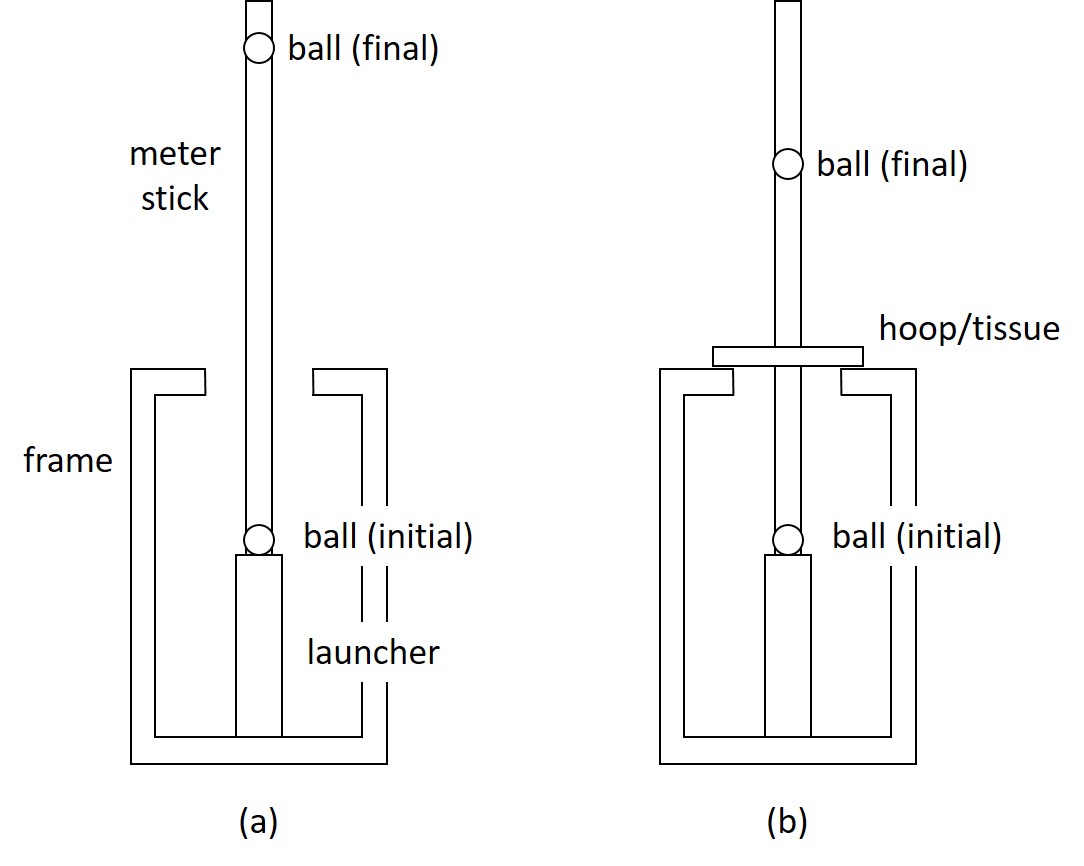
To measure the energy (\(E_t\)) required to rupture a tissue, you will measure the maximum height of the launch both without (\(h_0\)) and with (\(h_1\)) a tissue in place. To avoid errors due to parallax, try to get your eye level with the maximum height of the ball’s trajectory. The same person should prepare the tissue each time using a consistent technique to increase repeatability of the measurements. Consider, for example, the tension of the tissue once it is mounted and whether the hoop is mounted with the tissue facing up.
Perform practice launches until you have developed a consistent technique.
Record a few notes in your lab notebook:
- Draw a simple diagram of your apparatus and label the height of the ball position and the height of the tissue. Add a caption describing the setup.
- Roughly, what is \(h_0\)?
- Roughly, what is \(h_1\)?
4 Gather and Analyze Data: Tearing Energy
Embed a new Excel spreadsheet in your notebook (Insert > Spreadsheet > New Excel Spreadsheet) and record the maximum height for one launch without a tissue and one launch with a tissue. Compute the energy required to rupture one tissue, \(E_t\), where \(E_t = mg(h_0 - h_1)\) (the mass of the ball is 17 g). Repeat this measurement and calculation 4 more times (5 total).
\[ E_t = mg(h_0 - h_1) \]
See Lab 1 if you need a refresher on writing formulas in Excel.
Compute the mean, standard deviation, and standard deviation of the mean of your 5 values of energy loss (\(\overline{E_t}\), \(\sigma_{E_t}\), and \(\sigma_{\overline{E_t}}\)). Report the statistics in your lab notebook, as well as answering the following:
- What is the mean energy to rupture a tissue based on your measurements? Your statement should involve uncertainty and indicate whether you are reporting the uncertainty in a single measurement or the uncertainty in the mean.
5 Analyze Data: Propagating Uncertainty
Another way to find the uncertainty in \(E_t\) is to propagate the uncertainty in the heights (\(\sigma_{\overline{h_0}}\) and \(\sigma_{\overline{h_1}}\)) through the equation \(E_t(h_0, h_1) = mg(h_0 - h_1)\).
Read through Section 10 and Section 11 at the end of this lab guide.
Use the formula from Section 10 to calculate \(\sigma_{\overline{E_t}}\) for your data. How does this compare to the uncertainty you calculated for \(\overline{E_t}\) in Section 4?
6 Predict: Number of Tissues
You will now use this information to make a prediction about how many tissues it takes to stop your ball launched from your launcher.
Make a sketch in your lab notebook similar to the one in Figure 1 (b), but with multiple hoops stacked on top of each other, and label the relevant distances representing your observations.
You derived the equation for the number of tissues your projectile could rupture, \(N\), in the prelab. The equation for the uncertainty in \(N\) is derived for you in Section 11.
Record the equation for \(N\) in your notebook for reference. Use Excel to compute a value for \(N\), the number of tissues you predict will rupture, along with your uncertainty in this number. Record your prediction for the maximum number of tissues. What does this prediction mean, and what role does the uncertainty you computed play in your predicted number of tissues? Use probabilistic language (i.e. “likely” or “unlikely”).
7 Gather Data and Compare: Testing Your Prediction
Based on your prediction, decide the minimum number of tissues to place above the launcher needed to verify your prediction. Perform that experiment once.
Explain how your results compare to your prediction.
8 Draw Conclusions: Uncertainty and Predictions
Answer the following questions in your lab notebook:
- How did the uncertainty in the results of your measurements affect the prediction you made?
- When using the formulas at the end of Section 11, for each measured quantity involved, did you decide to use \(\sigma\), SDOM, (or something else)? Briefly, justify your decisions.
9 Reflect
Briefly, record responses to the following in your lab notebook:
- Describe something that worked well when doing the lab activity today.
- How did you contribute to this success?
10 Appendix A: Error Propagation – Analytic
In general, there is an analytic procedure for propagating uncertainty that uses calculus. One key result is how to calculate the uncertainty in a calculated quantity based on the measured quantities that are added, subtracted, multiplied, or divided.1
First, suppose a calculated quantity \(\bar{f} = a\bar{x}\) depends on a measured quantity \(\bar{x}\) and a known parameter \(a\). Note that \(a\) could be simply a numerical factor (i.e. 7) or a very precisely known constant (i.e. the speed of light). In this case,
\[ \sigma_{\bar{f}} = |a| \, \sigma_{\bar{x}} \]
Second, suppose a calculated quantity \(\bar{g} = \bar{x} + \bar{y}\) or \(\bar{g} = \bar{x} - \bar{y}\) depends on measured quantities \(\bar{x}\) and \(\bar{y}\). In both cases,
\[ \sigma_{\bar{g}} = \sqrt{\sigma_{\bar{x}}^2 + \sigma_{\bar{y}}^2} \]
Third, suppose a calculated quantity \(\bar{k} = \bar{x} \, \bar{y}\) or \(\bar{k} = \bar{x} / \bar{y}\) depends on measured quantities \(\bar{x}\) and \(\bar{y}\). In both cases,
\[ \frac{\sigma_{\bar{k}}}{|\bar{k}|} = \sqrt{\left(\frac{\sigma_{\bar{x}}}{|\bar{x}|}\right)^2 + \left(\frac{\sigma_{\bar{y}}}{|\bar{y}|}\right)^2} \]
11 Appendix B: Error Propagation – Tissue Lab
For this lab, consider the equation for the energy to rupture one tissue.
\[ E_t(h_0, h_1) = mg(h_0 - h_1) \]
where \(h_0\) is the height of the ball without a tissue in place and \(h_1\) is the height after breaking through one tissue.
The uncertainty in the mean value of \(E_t\) is given by
\[ \sigma_{\overline{E_t}} = mg \sqrt{\sigma_{\overline{h_0}}^2 + \sigma_{\overline{h_1}}^2} \]
Now consider the equation for the number of tissues the ball will rupture.
\[ N = \frac{mgh_0 - mgh_{\text{platform}}}{mgh_{\text{hoop}} + E_t} \]
where \(h_{\text{hoop}}\) is the small thickness of a single hoop, and \(h_{\text{platform}}\) is the height of the bottom of the stack of hoops.
The uncertainty in the value of \(N\) is given by
\[ \sigma_N = N \sqrt{\left(\frac{\sigma_{E_{\text{ball}}}}{E_{\text{ball}}}\right)^2 + \left(\frac{\sigma_{E_{\text{loss}}}}{E_{\text{loss}}}\right)^2} \]
where
\[ E_{\text{ball}} = mgh_0 - mgh_{\text{platform}} \]
\[ E_{\text{loss}} = mgh_{\text{hoop}} + E_t \]
\[ \sigma_{E_{\text{ball}}} = mg \sqrt{\sigma_{h_0}^2 + \sigma_{h_{\text{platform}}}^2} \]
\[ \sigma_{E_{\text{loss}}} = \sigma_{E_t} \]
assuming the uncertainty in \(h_{\text{hoop}}\) is negligible compared to the other uncertainties.
All \(\sigma\)s in this appendix represent the uncertainty in the quantity.
These results are only true if the two quantities are independent of each other. That is the case for most situations we’ll encounter in this class.↩︎